Monday, February 18, 2019

TRUE NARRATIVE ESSAY – UNFORMULATED ESSAY

TRUE NARRATIVE ESSAY – UNFORMULATED ESSAY

¨a creative story, based on actual events by using the nebulous nature of literature.

ELEMENTS
¨nebulous nature of literature
1. Figures of speech, especially: analogy, satire, hyperbole, metaphor, rhetoric, foreshadow, imagery.
2.Literary techniques & devices

PURPOSE (thesis)
¨ to express a point or actual observation.

POV
¨1ST person
¨3RD person


Sunday, February 3, 2019

REFLECTIVE ESSAY (CNF FORM & TYPE)

REFLECTIVE ESSAY (CNF FORM & TYPE)
-An essay which the writer examines his or her experiences in life.
-Aka. Reflection Essay.

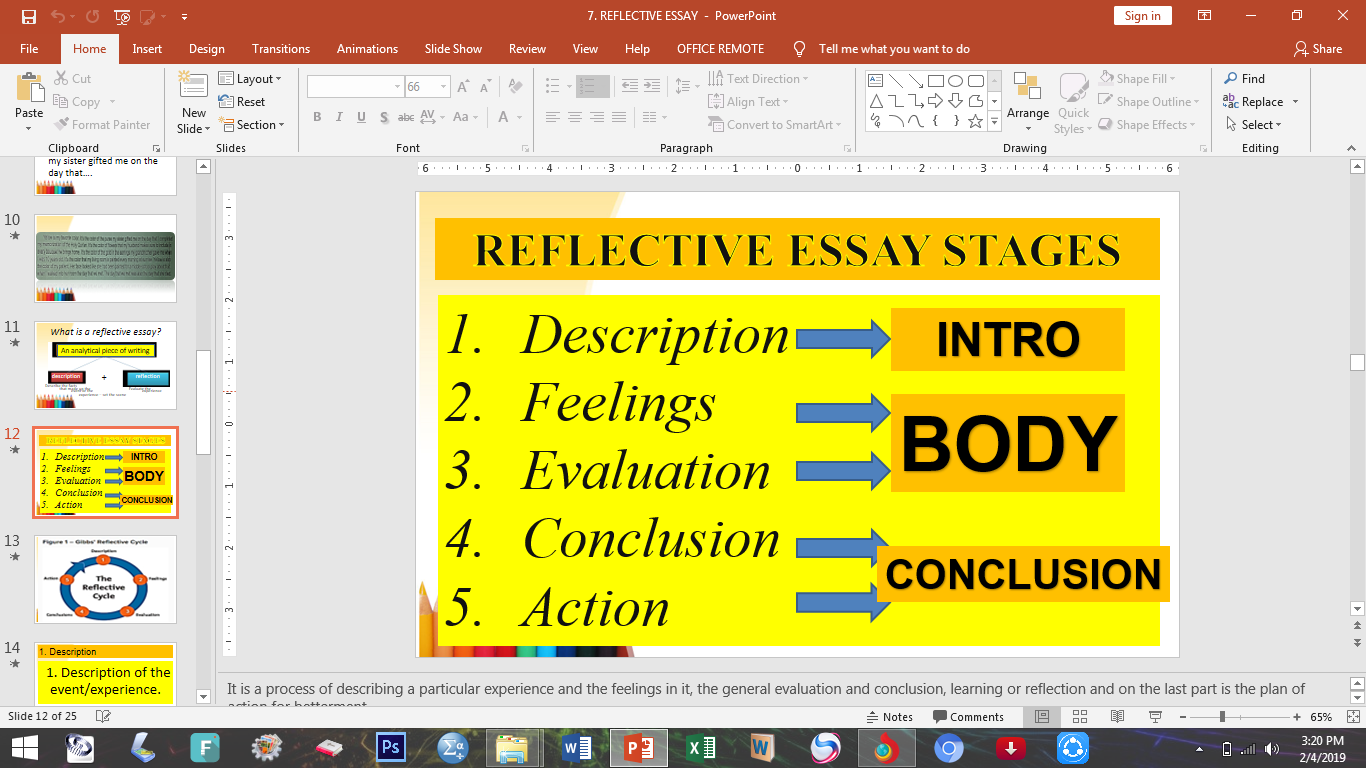
REFLECTIVE ESSAY STAGES
1. Description of the event/experience.
2. Feelings at the time (of experience)
  
3. Evaluation & Analysis
  a. Evaluation of the event/experience (what was good or bad about it)
  b. Analysis of the event/experience (cause and effect, compare and contrast)
4. Conclusions
a. General Conclusion (the overall idea of the described experience)
b. Specific Conclusion (the specific idea of the described experience)
5. Action
What steps are you going to take after learning something?

THE VALLEY OF AMAZEMENT (EXCERPT) BY AMY TAN (USA)


Guide Questions
1.       What was Lulu’s reaction when she found out about the operation? Do you think her reaction is normal? Why or why not?
2.      Do you think the parents made a mistake in operating on Lulu’s fingers? Why or why not?
3.     Why do think is its effect on the narrator?
4.     What does it mean when she wanted to be true to her Self?
5.     Is the narrator expressing an inherently Asian or American value?
6.     Do childhood revelations have a lasting impact on one’s life? Explain your experience.

7.     In what context (of nation/race, environment) the text was written? Why do you think so?

Wednesday, January 30, 2019

A THOUSAND SPLENDID SUNS (EXCERPT) BY: KHALED HOSSEINI

READING LITERATURE:
A THOUSAND SPLENDID SUNS
(EXCERPT)
BY: KHALED HOSSEINI

UNLOCKING OF DIFFICULTY:
  1. Burqa - a piece of clothing that covers a woman
  2. Hem - the edge of a piece of cloth
  3. Unnerving - Inspiring fear
  4. Mosque – Muslim place of worship
  5. Skewer - a pin of wood or metal to fasten/ hold a meat
  6. Swatted – hit by a blow
  7. Odd – unusual
  8. Morsel – a piece of food
  9.  Cantering – walking, jogging
  10. Whiff – smell, aroma


GUIDE QUESTIONS:

  1. Who were the characters in the story?
  2. Where was the setting?
  3. What do you think a burqa symbolizes for Afghan and/or Muslim society?
  4. Would you ever want to wear a burqa? Why or why not?
  5. Why does Mariam compare herself to the other women?
  6. Why is it important to show in the story that there are also modern women in Afghanistan?
  7. What is the theme or focus of the story? Why so?


Monday, January 28, 2019

PERSONAL NARRATIVES

PERSONAL NARRATIVES

“VERISIMILITUDE”

The ¡The appearance of being true or real. (Oxford English Dictionary)
Based on history
¡Printed essays in the Philippines came with the Spanish conquistadors. The Spanish missionaries printed the following:
ØMeditation;
ØTranslations;
ØStudies of Philippine Languages; and
ØExplanation of Christian tenets.

Filipinos personal essays in SPANISH language
1.Memorias/apuntes – memoirs
2.Informes – accounts/narratives
3.Memoriales – reports

Personal/informal/familiar essays
1.Autobiography
2.Biography
3.Diary
4.Journal
5.Memoir (record)
6.Travelogue (Travel Journal/ Travel Writing)
7.Personal Narrative (Personal Essay)

Personal narrative

A ¡a form of writing in which the writer relates one event, incident, or experience from his/her life. McClure
¡Also called ‘Personal Essay’

Write a Personal Narrative that:

1.Engages the reader by introducing the narrator and situation
2. Organizes events to unfold naturally; manipulates time and pacing
3.Develops details of events with description and action
4.Develops characters with physical description and dialogue
5. Uses vivid verbs, sensory details, similes, metaphors, alliteration, onomatopoeia, and personification to set tone and mood
6. Uses transitions and varies sentence beginnings
7. Closes with a reflection
8. Has exemplary presentation

TRAVELOGUE - CNF

TRAVELOGUE

Matsuo Basho

¡The most famous poet of the Edo period in Japan, and not only known as the greatest master of Haiku, but also famous for publishing his travel journals based on his travel to Kyoto, Nara, and Euno in late September of 1684-87.
¡Travelogue of Jose Rizal on June 23, 1882

TRAVEL WRITING / TRAVELOGUE
- a form of creative nonfiction in which the narrator's encounters with foreign places serve as the dominant subject. Also called travel literature.
- writing about a place that you have visited
It’s about relaying your travel experiences to others.

Travel literature forms:
¡Travel writing
¡Travel journal
¡Travelogue
¡Travel blog
¡Travel guide
¡Travel essay
¡Travel narrative
¡Adventure literature
¡Outdoor and foreign travel of literature
¡Nature writing
¡Exploration literature

Travel blogs
¡In the 21st century, travel literature became a genre of social media in the form of travel blogs, with travel bloggers using outlets like: personal blogs, Pinterest, Twitter, and Instagram to convey information about their adventures and provide advice for navigating particular countries, or for traveling generally. 

characteristics
1. Literary Elements
2. Journalistic Elements
¡(Exactly when and where)-setting
¡Figures of Speech
¡Characterization
¡Dialogue
¡Descriptive Words
3. Reflection/learning


Tuesday, January 22, 2019

BIOGRAPHY, AUTOBIOGRAPHY & LITERARY JOURNALISM

Biography, autobiography, & literary journalism

1. BIOGRAPHY

Abiography is about somebody else’s life.
   - It is about a real person but is not written by the person. It is written in the third person.
describes key facts about a person.
 such as, where, when and how they live (or have lived if the person is no longer alive)/
Provides details that show events in a person’s life.
A biography will talk about how a person feels about different things.


2. Autobiography
AAn autobiography is written in the first person because it contains facts about the author’s own experiences.
¢An autobiography recounts key incidents/events in the author’s life.
¢An autobiography describes influences upon the author.
¢describes interactions between the writer and significant people in his or her life.


3. LITERARY JOURNALISM

Aform of nonfiction that combines factual reporting with some of the narrative techniques and stylistic strategies traditionally associated with fiction.
¡Aka “narrative journalism”.

John mcphee¡One of the pioneers of CNF.
¡His journalistic style of writing is coupled with literary elements – narrative structure, characterization, scene setting, internal POV, tension, symbolism, etc.
Thomas B. Connery
¡Literary Journalism is 'nonfiction printed prose whose verifiable content is shaped and transformed into a story or sketch by use of narrative and rhetorical techniques generally associated with fiction.'
characteristics

       1.Immersion reporting2.Details of Environment (SETTING)3.Dramatic Scenes
4.Dialogue5.Character development6.“Expressive” (Figures of Speech) with Symbolism7.Author’s Voice or Opinion
8.Third Person POV9.Careful & Precise Word Selection


Rules
¡Mark Kramer used the term 'breakable rules':
1. Literary journalists immerse themselves in subjects' worlds.
2. Literary journalists work out implicit covenants about accuracy and candor.
3. Literary journalists write mostly about routine events.
4. Literary journalists develop meaning by building upon the readers' sequential reactions.


***************************************************

INDIVIDUAL PETA: CNF BOOKLET


1. AUTOBIOGRAPHY COMPOSITION

2. LITERARY JOURNALISM COMPOSITION 
  
 (RECENT REAL ACTIVITY/PROGRAM - IN SCHOOL, BARANGAY, COMMUNITY,    
   MUNICIPALITY OR PROVINCE)

Featured Post

CORALINE BY NEIL GAIMAN (ENGLAND)

CORALINE BY NEIL GAIMAN (ENGLAND) Coraline [Excerpt] by Neil G...